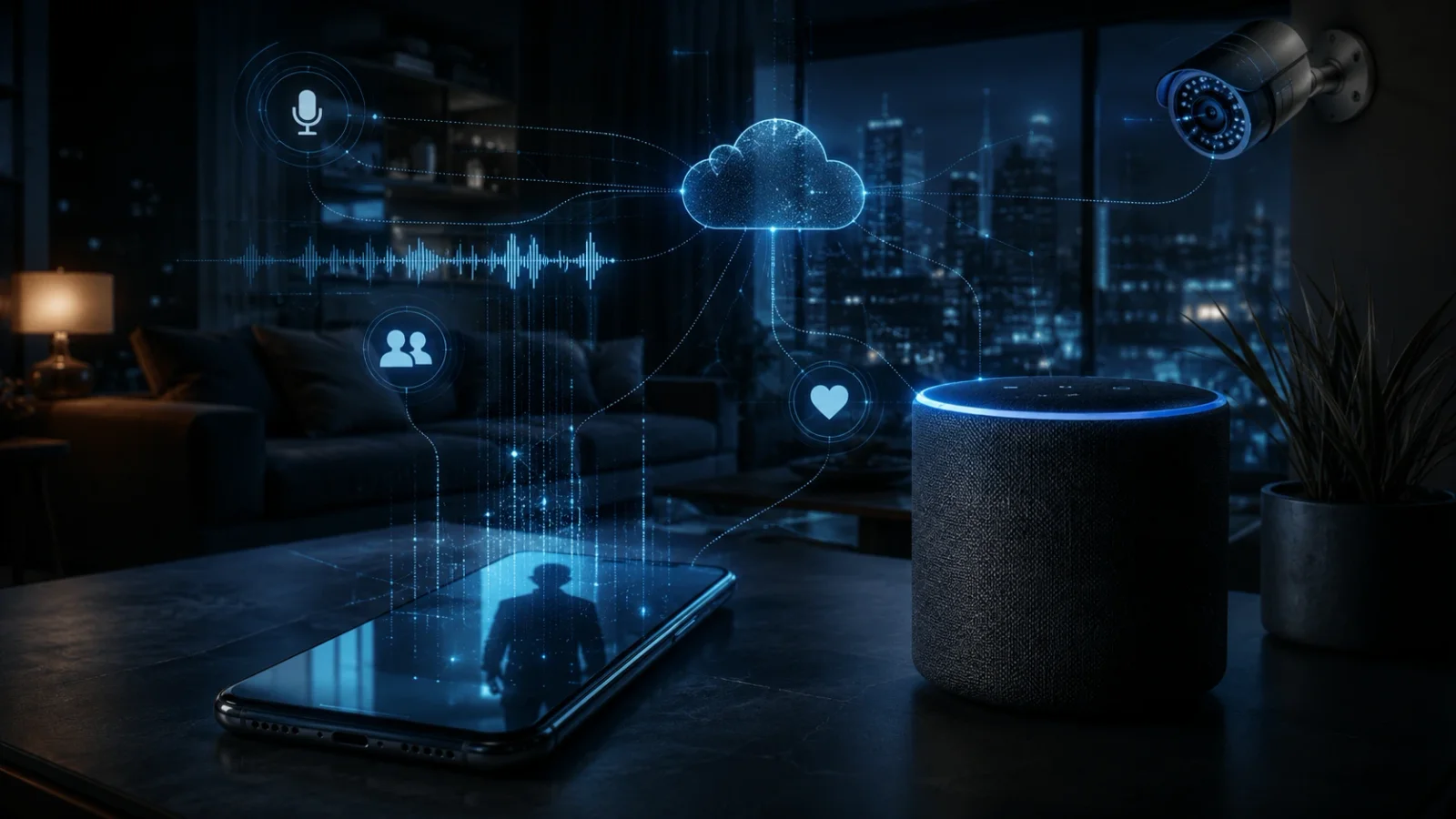
Why “You’re Already Being Watched” Is the Worst Argument in Modern Privacy
Introduction: The lazy privacy argument
You have probably heard this argument before:
“Why are you so worried about your Amazon device listening in? You own a smartphone. That has a microphone. It has a camera. There is no camera shutter, so it is always on. You have already been spied on for the last twenty years. You share your whole life on social media anyway. What is the point in caring anymore?”
It sounds clever.
It is not.
It is a classic example of privacy fatalism: the belief that because some privacy has already been lost, all privacy is pointless.
That attitude is not technical. It is not strategic. It is not even realistic.
It is surrender dressed up as logic.
The truth is more uncomfortable and more useful: yes, smartphones are one of the most powerful surveillance devices humans have ever voluntarily carried. Yes, advanced actors can turn compromised phones into eavesdropping tools. Yes, social media has trained people to overshare. Yes, smart speakers listen for wake words. Yes, cameras, microphones, sensors, apps, cloud accounts, ad networks, and data brokers have created an enormous surveillance economy.
But none of that means privacy no longer matters.
It means privacy needs to be understood properly.
A smartphone, an Amazon Echo, a Ring camera, a social media profile, a cloud backup, a malicious app, a compromised phone, and a data broker are not the same thing.
They are different systems.
Different systems create different risks.
Different risks require different boundaries.
The core mistake: treating privacy as all-or-nothing
The statement “you already have a smartphone, so why worry about Alexa?” fails because it treats privacy as binary.
Either you are private, or you are not.
Either you are watched, or you are not.
Either you have something to hide, or you do not.
That is not how privacy works.
Privacy is not a single wall. It is a set of boundaries.
You may be comfortable sharing a photo on Facebook but not comfortable with your bedroom camera being remotely accessed.
You may allow a navigation app to use location while driving but not want every app on your phone tracking you in the background.
You may use a voice assistant in the kitchen but not want one in the bedroom.
You may post a holiday photo but not want a smart speaker accidentally capturing a private argument.
You may send voice notes to friends but not want a corporation storing voice interaction history indefinitely.
Those are not contradictions.
That is context.
Privacy is not secrecy. Privacy is control over context.
The fact that you reveal one part of your life does not mean you consent to every other part being captured, stored, analysed, sold, breached, requested, or misused.
Sensor presence is not the same as sensor access
A smartphone having a microphone does not automatically mean the microphone is recording.
A smartphone having a camera does not automatically mean the camera is active.
A smart speaker having a microphone does not automatically mean every conversation is being uploaded.
But the opposite is also true: just because a device is not visibly recording does not mean there is no privacy risk.
The correct technical question is not:
“Does this device have a microphone?”
The correct technical question is:
“What activates the microphone, where is the audio processed, who can access it, how long is it stored, and what can be inferred from it?”
That is the difference between panic and threat modelling.
A microphone is hardware.
Eavesdropping is a system behaviour.
A camera is hardware.
Surveillance is a data pipeline.
A smart speaker is not dangerous simply because it has a microphone. It becomes a privacy concern because of its activation model, cloud dependency, account linkage, third-party integrations, retention settings, and placement inside private spaces.
A phone is not dangerous simply because it has sensors. It becomes a privacy concern because it follows you, identifies you, authenticates you, tracks you, stores your life, and can become a high-value target for compromise.
Good privacy analysis looks at the entire chain:
Sensor availability
Permission model
Activation trigger
Local processing
Cloud processing
Account linkage
Data retention
Human review
Third-party integrations
Law enforcement access
Internal employee access
Breach exposure
Data resale
Behavioural inference
User control
Deletion rights
Auditability
When someone says, “your phone has a mic too,” they are skipping nearly the entire security model.
“Always listening” does not always mean “always recording”
Smart speakers are often described as “always listening.”
Technically, that needs to be unpacked.
Most voice assistants continuously listen locally for a wake word, such as “Alexa.” That means the device is processing short snippets of sound to detect whether the wake word has been spoken. When the wake word is detected, the following command may be sent to cloud servers for interpretation, processing, and response.
So there is a difference between:
“The device is listening for a wake word.”
and:
“The device is recording and uploading everything all the time.”
Those are not the same claim.
But that does not mean the risk disappears.
Wake-word detection can trigger accidentally. Background speech can be captured. Voice requests can reveal habits. A simple command like “turn off the bedroom light” can disclose presence, routine, room usage, and household behaviour.
The privacy issue is not only the words spoken directly to Alexa.
The issue is the environment around the device.
A smart speaker is not just a microphone.
It is an ambient behavioural sensor.
The kitchen microphone is not the same as the phone in your pocket
A smartphone is personal.
A smart speaker is environmental.
That difference matters.
Your phone usually belongs to you. It travels with you. It has a screen. It has permission prompts. It has app settings. You can lock it, turn it off, put it in airplane mode, or leave it in another room.
A smart speaker is different.
It sits in a room and waits.
It is used by multiple people.
It may hear guests, partners, children, cleaners, clients, carers, tenants, or neighbours through thin walls.
It may be connected to lights, locks, purchases, music, calendars, reminders, shopping lists, cameras, doorbells, thermostats, and routines.
It may be controlled by one account while affecting an entire household.
That creates a bystander privacy problem.
The person who owns the device is not always the only person captured by the device.
That is one of the biggest differences between personal computing and smart home infrastructure.
The smart home turns private spaces into sensor-managed spaces.
That does not mean smart home devices should never be used.
It means they should not be treated like harmless furniture.
The intelligence-grade reality: phones can become room bugs
There is another uncomfortable truth: under compromise, a smartphone can become one of the most powerful eavesdropping tools a person owns.
From an intelligence and cyber-operations perspective, the phone is the crown jewel.
It is personal.
It is portable.
It is always nearby.
It is sensor-rich.
It is trusted by the user.
It contains messages, photos, contacts, location history, authentication tokens, calendars, banking apps, browser history, cloud sessions, and private conversations.
If a phone is successfully compromised, the privacy model changes completely.
At that point, the issue is no longer whether an app has normal microphone permission. The issue is whether an attacker has gained enough control to bypass or abuse the normal user-facing permission system.
A sufficiently advanced compromise may attempt to collect messages, track location, activate sensors, capture files, observe notifications, or exfiltrate data without the user understanding what is happening.
This is not science fiction.
This is the high-end threat model behind modern mercenary spyware, state-level surveillance, and targeted digital operations.
But here is where people make the wrong leap.
The existence of advanced phone compromise does not prove that privacy is pointless.
It proves the opposite.
It proves that phones are high-value surveillance targets and should be treated as such.
The correct conclusion is not:
“Your phone can be hacked, so why care about Alexa?”
The correct conclusion is:
“Your phone is already a major surveillance risk, so stop adding more microphones, cameras, accounts, and cloud-linked sensors into private spaces without thinking.”
A compromised phone is targeted surveillance.
A smart speaker is ambient infrastructure.
A malicious app is permission abuse.
A social media profile is voluntary disclosure.
A data broker is commercial correlation.
A Ring camera is visual environmental monitoring.
A cloud backup is stored historical exposure.
These are different threat models.
Treating them as the same thing is how people become careless.
“No camera shutter” is a valid criticism, but not proof the camera is always on
The lack of a physical camera shutter on many phones is a legitimate privacy criticism.
Hardware privacy controls are stronger than software privacy controls because they reduce the amount of trust required.
A physical shutter blocks the camera.
A hardware microphone switch can physically interrupt audio capture.
A software indicator only tells you what the operating system claims is happening.
That difference matters.
However, saying “there is no camera shutter, so the camera is always on” is technically inaccurate.
The stronger argument is this:
“Phones rely heavily on software-enforced privacy controls, and software controls are only as trustworthy as the operating system, firmware, app model, and absence of compromise.”
That is a serious argument.
It is much better than saying the camera is simply “always on.”
A proper security analysis distinguishes between:
A camera physically existing
A camera being granted permission
A camera being actively used by an app
A camera being accessed in the background
A camera being abused by malware
A camera being controlled under advanced compromise
A camera being physically blocked by a shutter
Those are not the same thing.
The technical world lives in those distinctions.
Privacy fatalism destroys those distinctions.
Social media sharing is not consent to total surveillance
The “you share your life on social media anyway” argument is one of the weakest privacy arguments.
Yes, many people overshare online.
Yes, social media creates long-term privacy risk.
Yes, public posts can reveal location, relationships, habits, beliefs, work patterns, wealth, health, travel, sexuality, family structure, and emotional state.
But voluntary disclosure is not the same as passive capture.
Posting a selfie does not mean you consent to your private conversations being recorded.
Sharing a restaurant photo does not mean every movement should be sold through a location broker.
Uploading a family picture does not mean a smart camera should be able to expose your home.
Writing a public opinion does not mean your private messages should be harvested.
Privacy is contextual.
Consent is contextual.
Disclosure is contextual.
If someone opens their front door to receive a parcel, that does not mean every stranger has permission to walk into the bedroom.
The same applies digitally.
Just because a person shares something somewhere does not mean they have surrendered everything everywhere.
The real danger is data fusion
Modern surveillance is not powerful because of one device.
It is powerful because of correlation.
A single Alexa command may seem harmless.
A single phone location ping may seem harmless.
A single Ring video may seem harmless.
A single social media post may seem harmless.
A single app permission may seem harmless.
A single purchase record may seem harmless.
But when those signals are combined, they create a behavioural profile.
That profile can reveal:
When you wake up
When you sleep
When you leave home
Who visits you
What room you are in
What you buy
What you watch
What you search
What you ask
What you fear
What you believe
Who you talk to
Where you worship
Where you work
Where you drink
Where you seek medical help
When you are alone
When your home is empty
Which relationships are unstable
Which habits repeat
Which vulnerabilities can be exploited
That is the real privacy issue.
Not one microphone.
Not one camera.
Not one post.
The danger is the model built from all of them.
Once data becomes machine-readable, it can be searched, scored, sold, leaked, subpoenaed, breached, misinterpreted, used for advertising, used for fraud detection, used for insurance pricing, used for employment screening, used for law enforcement, or used to manipulate behaviour.
The question is not only:
“What did I reveal?”
The question is:
“What can be inferred from what I revealed, when I revealed it, where I revealed it, and what other data can be connected to it?”
That is where privacy becomes a systems problem.
“They have been spying for twenty years” is not a reason to give up
Yes, digital tracking has existed for decades.
Cookies, browser fingerprints, ad networks, mobile identifiers, loyalty cards, CCTV, email tracking pixels, smart TVs, Bluetooth beacons, Wi-Fi probes, GPS data, app telemetry, and social media analytics have been building profiles for years.
But long-term exposure does not make harm reduction pointless.
A person who smoked yesterday still benefits from smoking less today.
A company that leaked data last year still needs better security this year.
A house with one weak window should not leave every door unlocked.
Privacy is cumulative, but so is protection.
Every reduction matters:
Fewer unnecessary devices
Fewer active microphones
Fewer indoor cameras
Less location sharing
Shorter retention periods
Fewer third-party integrations
Stronger account security
Better app permissions
Reduced cloud dependency
More hardware switches
Better separation between accounts
Regular deletion of stored voice and location history
The goal is not perfect invisibility.
Perfect invisibility is unrealistic for most people.
The goal is attack surface reduction.
That is the same logic used in cybersecurity generally.
You do not say, “This system has one vulnerability, so let us abandon all patching.”
You reduce exposure layer by layer.
Privacy works the same way.
The smart home changed the privacy boundary
Historically, the home was private by default.
A conversation in the kitchen stayed in the kitchen.
A family argument stayed inside the house.
A child playing in the living room was not automatically part of a cloud-connected system.
A visitor did not need to wonder which devices were listening.
The smart home changed that.
Smart speakers, doorbell cameras, indoor cameras, smart TVs, baby monitors, pet cameras, smart locks, thermostats, motion sensors, and connected appliances have turned the home into a networked environment.
That creates new questions:
Who owns the data from the home?
Who controls the account?
Who can review recordings?
Are guests informed?
Are children captured?
Are neighbours recorded?
Can employees access the data?
Can police request the data?
Can hackers access the device?
Can the vendor change the privacy policy?
Can the data be used to train models?
Can recordings be deleted fully?
Can the device work without cloud processing?
These are not paranoid questions.
They are normal architecture questions.
If a device is inside a private space, it deserves a higher privacy standard.
Convenience is not free; it is exchanged for trust
Voice assistants are popular because they are convenient.
You can set timers, play music, control lights, check weather, ask questions, manage shopping lists, call people, trigger routines, and control devices without touching a screen.
That is useful.
But convenience is not free.
You are exchanging friction for trust.
You trust the device to wake only when intended.
You trust the company to process only what is necessary.
You trust the account not to be compromised.
You trust third-party integrations not to abuse access.
You trust employees and contractors not to misuse internal tools.
You trust deletion controls to work as expected.
You trust privacy settings not to be weakened later.
You trust the business model not to shift against you.
That is a large trust stack for a device sitting inside a private home.
This does not mean nobody should use Alexa, Siri, Google Assistant, Ring, or smart home technology.
It means users should understand the trade.
A privacy-aware position is not:
“Never use technology.”
A privacy-aware position is:
“Use technology with boundaries.”
A mature privacy posture
The correct response to modern surveillance is not panic.
It is architecture.
For normal users, that means:
Do not place smart speakers in bedrooms or bathrooms.
Use microphone mute buttons during sensitive conversations.
Review and delete voice history.
Disable unnecessary voice recording retention where possible.
Audit third-party Alexa skills and smart home integrations.
Do not connect voice assistants to purchases, locks, or sensitive actions without confirmation.
Review phone app permissions regularly.
Remove microphone, camera, contacts, Bluetooth, and location access from apps that do not need them.
Use strong passwords and multi-factor authentication.
Keep phone operating systems updated.
Avoid installing unknown apps, profiles, APKs, or configuration tools.
Prefer devices with physical shutters and hardware mute controls.
Treat indoor cameras as high-risk devices.
Separate smart home accounts where practical.
Think before linking every service to one identity.
For high-risk users, such as journalists, activists, executives, political figures, legal professionals, intelligence targets, or people involved in sensitive disputes, the posture should be stronger:
Use hardened device settings.
Reduce installed apps.
Avoid unknown links and attachments.
Keep sensitive conversations away from consumer smart devices.
Use separate devices for sensitive work.
Disable unnecessary radios and services.
Avoid cloud syncing of sensitive material.
Use encrypted communications carefully.
Treat phone compromise as a realistic threat model.
Seek professional security support when targeted.
For companies building these systems, the requirements are even clearer:
Data minimisation by default
Local-first processing where possible
Clear activation indicators
Hardware-level mute and shutter controls
Short retention periods
Strong deletion semantics
No broad internal access to customer recordings
Independent audit logs
Bystander-aware design
Transparent law enforcement request handling
Strong third-party integration review
Separation between product telemetry and advertising profiles
Privacy threat modelling before launch, not after scandal
Privacy is not a feature toggle.
It is a design discipline.
The better version of the original argument
The original statement is not completely useless.
There is a valid criticism hidden inside it.
People often worry about one privacy risk while ignoring another.
They complain about Alexa but grant microphone access to random apps.
They cover a laptop webcam but install suspicious browser extensions.
They fear smart speakers but post their location publicly.
They distrust Amazon but allow every app to track them.
They worry about government surveillance but ignore commercial surveillance.
That inconsistency is real.
But the conclusion should not be:
“Privacy no longer matters.”
The conclusion should be:
“Apply privacy thinking consistently.”
A better version of the argument would be:
“If you are worried about Alexa, you should also review your smartphone, apps, social media, cloud backups, location settings, smart cameras, browser extensions, and data-sharing habits.”
That is a serious argument.
That moves the discussion away from brand paranoia and toward system-level privacy.
Final position: caring still matters
The fact that smartphones can be used for surveillance does not make smart speakers harmless.
The fact that people overshare on social media does not make passive monitoring acceptable.
The fact that advanced actors can compromise phones does not make privacy pointless.
The fact that perfect privacy is impossible does not make practical privacy worthless.
Privacy is not about hiding wrongdoing.
Privacy is about autonomy.
It is about dignity.
It is about context.
It is about safety.
It is about controlling how much of your life becomes machine-readable.
The modern home is filling with microphones, cameras, sensors, assistants, and cloud-connected devices. The correct response is not blind fear. It is also not lazy surrender.
The correct response is technical literacy.
A smartphone in your hand, an Alexa device in your kitchen, a Ring camera at your door, a cloud backup of your voice history, a social media profile, and a compromised phone are different systems.
Different systems deserve different controls.
So yes, you should worry about your Amazon device listening.
You should also worry about your phone.
You should worry about your apps.
You should worry about social media.
You should worry about smart cameras.
You should worry about data brokers.
You should worry about account security.
You should worry about device compromise.
Not because panic is useful.
Because boundaries are useful.
And in the connected world, boundaries do not happen by accident.
They have to be designed, configured, defended, and revisited.
Share this article
Stay ahead of the threat
Breaking news, advisories and field reports from AckerWorx, straight to your inbox.