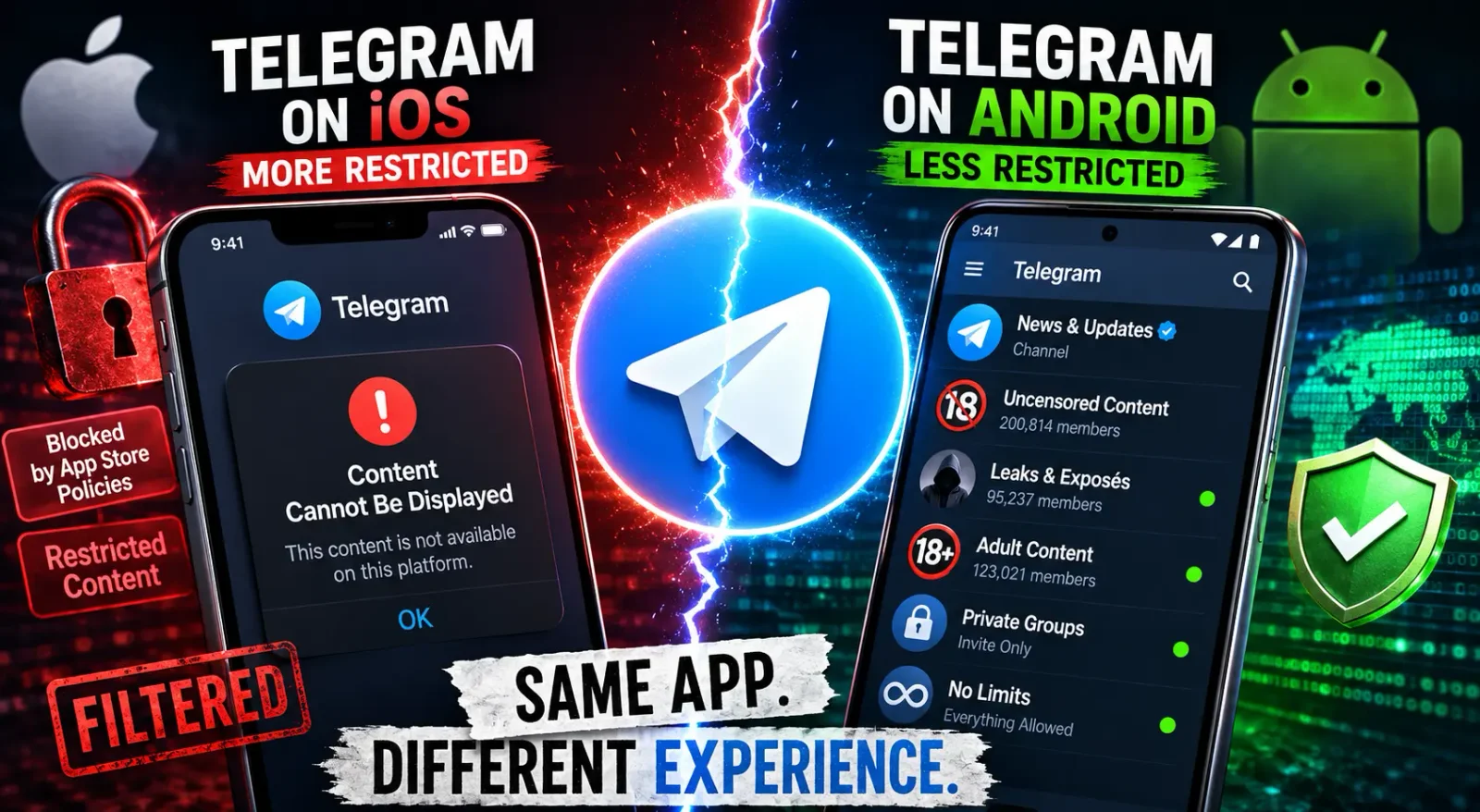
Telegram has a reputation for being fast, private, and less controlled than many mainstream messaging apps. But the version of Telegram you use matters. Telegram on iOS is not the same experience as Telegram installed directly from Telegram’s own Android APK.
On iPhone, Telegram has to live inside Apple’s App Store rules. On Android, especially when installed directly from Telegram’s website, the app can operate with fewer platform restrictions. That does not mean Android Telegram is “lawless” or completely unmonitored, but it does mean the iOS version is more likely to hide, block, or restrict certain content.
The key difference: Apple controls the gate
Apple’s App Store rules require apps with user-generated content to include moderation systems. Apple specifically says these apps must provide ways to filter objectionable material, report offensive content, block abusive users, and respond to concerns. Apple also says apps primarily used for pornographic content, anonymous random chat, threats, bullying, or similar misuse may be removed from the App Store.
That matters for Telegram because Telegram is not just a private messenger. It also has public channels, huge groups, bots, media sharing, usernames, and searchable communities. Telegram itself says users can create groups with up to 200,000 people and channels for broadcasting to unlimited audiences.
So when Telegram runs on iOS, it has to satisfy Apple as well as Telegram’s own internal policies. If a channel, bot, or chat is flagged as adult, illegal, abusive, or otherwise unacceptable under App Store policy, the iOS app may block it or show a “cannot be displayed” style restriction.
Android is different, especially the direct APK
Telegram openly states that its direct Android version from telegram.org has “fewer restrictions” and receives updates directly from Telegram rather than only through Google Play.
That single line explains a lot.
On Android, users can install Telegram from different sources. They can use Google Play, third-party app stores, or Telegram’s direct APK. The direct APK does not have to pass through Apple’s App Store review system, and Telegram has more freedom over what features, filters, and content access rules are exposed.
This is why a channel that disappears or is blocked on iPhone may still be visible on Android, especially when using Telegram’s own APK.
This does not mean Telegram is fully unmonitored
A common misunderstanding is that Telegram is completely private by default. It is not that simple.
Telegram’s regular cloud chats are designed to sync across devices. That convenience is part of Telegram’s core product: you can use it on multiple devices at the same time and access your history from phones, tablets, and desktops.
For stronger privacy, Telegram has “Secret Chats,” which are separate from normal cloud chats. That distinction matters: Telegram is secure in some ways, but not every Telegram conversation has the same privacy model.
Telegram’s own privacy policy also says it stores only the data it needs to operate as a secure and feature-rich messaging service, and that it processes data for legitimate interests including detecting and preventing fraud or security issues.
So the more accurate statement is this:
Telegram on Android, especially the direct APK, can be less platform-restricted than Telegram on iOS. But Telegram itself is still a centralized service with rules, reporting systems, metadata, moderation, and legal obligations.
Why iOS blocks adult or “dodgy” chats faster
If a Telegram chat contains pornography, illegal sexual material, abuse, scams, or content that violates App Store rules, the iOS app has a strong incentive to block or hide it. Apple’s rules specifically call out overtly sexual or pornographic material and require user-generated content platforms to filter objectionable material.
From Apple’s point of view, this is about making the App Store safe for mainstream users, minors, families, and regulators. From Telegram’s point of view, it means the iOS client has to be more conservative than Telegram’s direct Android client.
That is why two people using the same Telegram account may see different behavior depending on device:
iPhone: content may be hidden, blocked, or unavailable.
Android direct APK: the same content may still appear.
Desktop/Web: settings and visibility may differ again depending on Telegram’s filters, region, account status, and platform rules.
App Store privacy labels are not the same as Telegram privacy
The App Store listing for Telegram shows that the developer declares some data may be linked to the user, including purchases, location, contact info, contacts, user content, and identifiers. Apple notes that the privacy information is provided by the developer and may vary based on features used.
That does not automatically mean Apple reads your Telegram messages. It means Telegram’s iOS app, like other App Store apps, must disclose categories of data it may collect or process.
The real issue is not “Apple is reading Telegram.” The issue is that Apple controls what kind of app experience is allowed on iOS, and Telegram must adapt its iOS client to stay available in the App Store.
The security trade-off
iOS gives users a tightly controlled ecosystem. That can be good for malware protection, payment safety, app review, and parental safety. But it also means Apple can influence what apps are allowed to show.
Android gives users more installation freedom. That can be good for power users, researchers, developers, and people who want the original app from the developer. But it also increases the risk of installing fake APKs, modified clients, malware, or apps from untrusted sources.
For security-minded users, the safest Android route is not a random APK mirror. It is Telegram’s official Android download from telegram.org, because Telegram says that version is direct from them and protected by verifiable builds.
AckerWorx view
Telegram on iOS is not “less secure” in the technical sense. In some ways, iOS may be safer because of Apple’s stricter app controls. But it is less open and more heavily shaped by App Store moderation rules.
Telegram on Android, especially the direct Telegram APK, is closer to Telegram’s own unrestricted client experience. It can expose content and features that Apple may not allow on iPhone.
So the real comparison is not simply:
iOS = secure
Android = insecure
A better comparison is:
iOS Telegram = more platform-controlled, more filtered, more App Store compliant
Direct Android Telegram = less platform-restricted, more Telegram-controlled, more open, but with more user responsibility
For ordinary users, the iOS version may feel safer and cleaner. For technical users, researchers, journalists, moderators, and people investigating platform abuse, the Android direct version may show a more complete picture of what actually exists on Telegram.
That is exactly why the same “dodgy” chat can vanish on iPhone but remain accessible on Android.
Share this article
Stay ahead of the threat
Breaking news, advisories and field reports from AckerWorx, straight to your inbox.