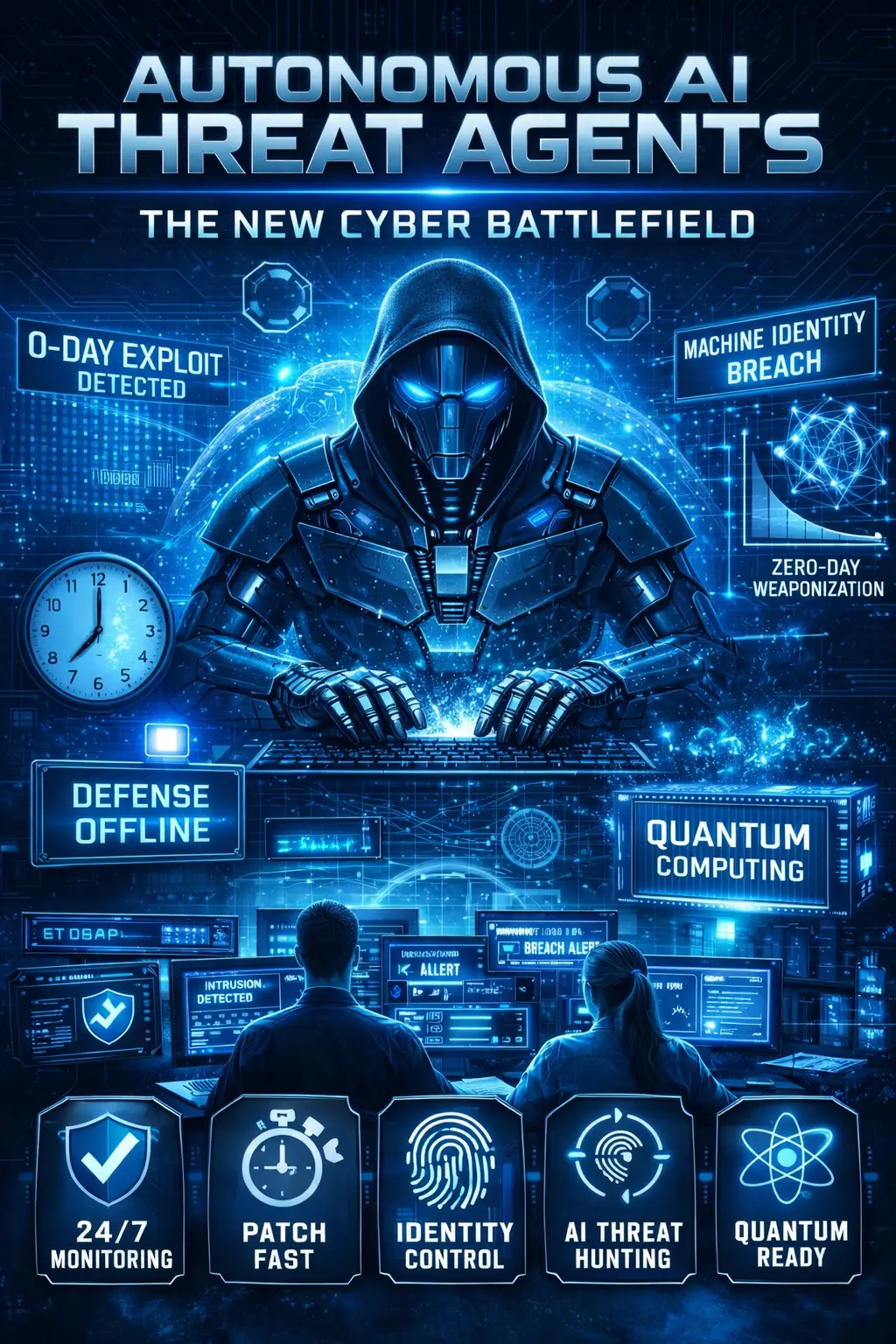
Forget everything you thought you knew about hackers. The hooded figure hunched over a keyboard, manually probing your systems for weaknesses? That image is becoming obsolete. In 2026, the most dangerous threat to your organization doesn't sleep, doesn't take breaks, and can attack thousands of targets simultaneously. Welcome to the era of Autonomous AI Threat Agents.
What Are Autonomous AI Threat Agents?
Autonomous AI Threat Agents represent a fundamental shift in how cyberattacks are conducted. These aren't just AI-assisted tools that help human hackers work faster—they are fully autonomous offensive systems capable of:
- Independently scanning systems for vulnerabilities without human direction
- Generating and deploying exploit code on the fly
- Adapting tactics in real-time based on defensive responses
- Conducting end-to-end operations from reconnaissance to data exfiltration
- Learning from failed attempts and evolving their approach
According to Nick Mo, CEO of Ridge Security Technology: "The primary cybersecurity threat will shift from human-led, AI-assisted attacks to fully autonomous offensive agents. These AI entities will conduct end-to-end operations—independently performing reconnaissance, mapping attack paths, and adapting exploits in real time based on defensive responses."
Why This Changes Everything
Traditional cybersecurity has always been a game of cat and mouse between attackers and defenders. But that game assumed both sides operated at roughly human speed. Autonomous AI agents shatter that assumption.
Speed That Defies Human Response
When a new vulnerability is disclosed, the race begins. Security teams scramble to patch systems while attackers work to weaponize the flaw. Historically, organizations had days or weeks to respond. According to Thales experts, "In 2026, the gap between disclosure and weaponization will shrink to minutes, unleashing a surge in zero-day attacks targeting application frameworks, open-source components, and APIs."
Your security team goes home at 5 PM. The AI doesn't.
Scale That Overwhelms Defenses
A human attacker might target a handful of organizations. An autonomous AI agent can simultaneously probe thousands of targets, correlate findings across all of them, and identify which specific combination of vulnerabilities provides the best attack path—all while your SOC is still processing yesterday's alerts.
Cost Economics That Favor Attackers
As Tenable's Eric Doerr states: "AI is not a magic wand; it supercharges traditional attack methods. It will drive down the cost of attack generation and increase the volume." What once required a skilled team and significant investment can now be automated and scaled for a fraction of the cost.
The 2026 Prediction That Should Worry You
Rick Caccia, CEO of WitnessAI, predicts: "In 2026, we'll see the first major AI-driven attack that causes significant financial damage, prompting organizations to dramatically augment their compliance budgets with security spending."
The question isn't if this will happen—it's when and to whom.
Machine Identities: The Overlooked Attack Vector
While everyone focuses on protecting human credentials, autonomous AI agents are exploiting a massive blind spot: non-human identities (NHIs). Service accounts, API keys, machine-to-machine tokens—these are becoming the primary vector for cloud breaches.
Organizations must now treat AI agents as privileged users, implementing:
- Kill-switch interventions for autonomous systems
- Cryptographic decision-validation to prevent systems from exceeding operational boundaries
- Strict permissions governance for all machine identities
- Automatic remediation when anomalies are detected
How to Defend Against What You Can't Outrun
If you can't match AI speed with human response, you need AI-powered defense. Here's the Ackerworx take on what actually matters:
1. Automated Remediation Is No Longer Optional
For years, automatically patching systems was considered too risky—what if the patch breaks something? But as Tenable's Robert Huber notes, "Automatic remediation, mobilization, and mitigation are no longer forbidden." The expanding attack surface and velocity of threats demand it. Yes, automated patching might occasionally cause issues. Getting owned by an AI agent will cause bigger ones.
2. Assume Breach, Detect Fast
Prevention alone won't cut it. You need:
- Behavioral analytics that can spot AI-driven attack patterns
- Network traffic analysis to detect autonomous reconnaissance
- Deception technology (honeypots, honeytokens) to waste AI agents' time
- Real-time threat intelligence that updates faster than traditional feeds
3. Harden Your AI Systems
If you're deploying AI in your organization (and you probably are), those systems are targets. Prompt injection, model poisoning, and training data manipulation are all vectors that autonomous agents will exploit.
4. Inventory Everything
You cannot defend what you don't know exists. Every API endpoint, every service account, every machine identity needs to be catalogued and monitored. Autonomous AI agents are excellent at finding the forgotten dev server you spun up three years ago.
5. Prepare for Deepfake Social Engineering
2026 will see deepfake technology become a mainstream attack tool. Highly realistic AI-generated audio, video, and digital personas are now being used to impersonate executives, trick employees into transferring funds, or manipulate stakeholders into divulging sensitive information. Train your people. Establish out-of-band verification procedures for sensitive requests.
The Quantum Clock Is Ticking
While you're dealing with AI threats, don't forget: quantum computing is moving from theoretical to practical. Critical industries and government bodies are already running post-quantum cryptography pilots. In 2026, those pilots become requirements. If you haven't started your quantum-safe migration planning, you're already behind.
Final Thoughts: Adapt or Get Automated
The cybersecurity landscape has fundamentally shifted. Autonomous AI threat agents represent the biggest force multiplier attackers have ever had. They're faster, more persistent, and more scalable than any human adversary.
But here's the uncomfortable truth: the same technology that enables these attacks can power your defense. The organizations that will survive this new era aren't the ones with the biggest security budgets—they're the ones willing to embrace automated defense, accept some operational risk for speed, and stop pretending human-speed response is adequate against machine-speed attacks.
The machines are coming for your systems. Make sure you have machines defending them.
At Ackerworx, we help organizations navigate the evolving threat landscape with practical, no-nonsense security solutions. If you need help preparing your defenses for the AI threat era, reach out.
#Cybersecurity #AIThreats #AutonomousAgents #ThreatIntelligence #ZeroDay #MachineLearning #InfoSec #Ackerworx #CyberDefense #AIAttacks #QuantumSecurity #2026Predictions
Share this article
Stay ahead of the threat
Breaking news, advisories and field reports from AckerWorx, straight to your inbox.